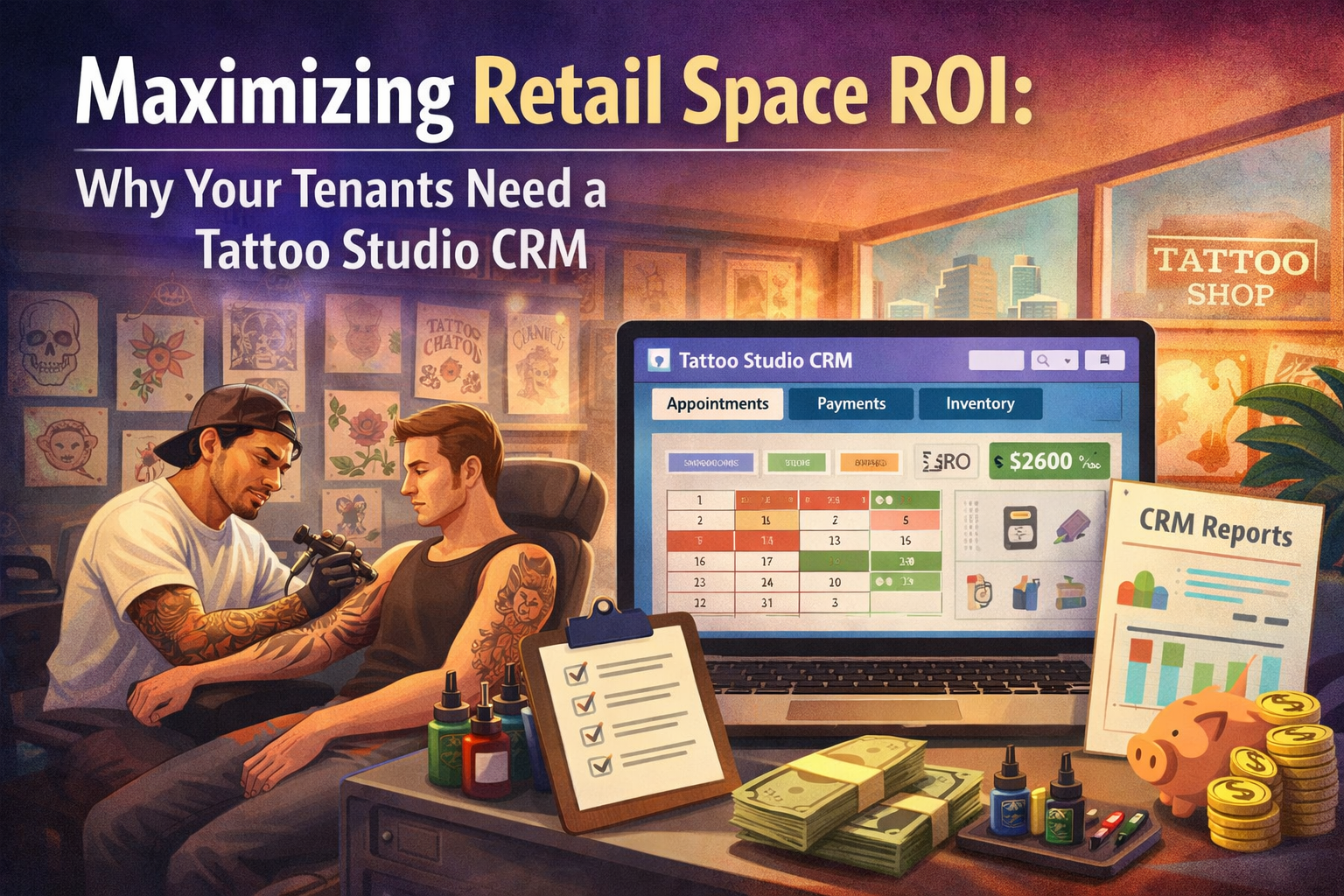
Protect your commercial real estate investments. Discover how a Tattoo Studio CRM helps tenants manage portfolios, secure bookings, and pay rent on time.
Table of Contents
I walk through a lot of empty retail space these days. If you’ve spent any time on the landlord side of the business, you know the absolute dread of a vacancy. Over the last decade, I’ve watched a massive shift in the types of tenants filling these street-level storefronts. The days of endless dry cleaners and discount apparel stores are fading, replaced by high-end, experiential businesses. Among the most lucrative and stable of these modern tenants? The boutique tattoo shop.
However, leasing to a body art facility isn’t just about handing over the keys and cashing a check. A shop is only as stable as its backend management. When evaluating a prospective tenant for a premium storefront, I always dig into their operational infrastructure. Specifically, I look to see if they utilize a dedicated Tattoo Studio CRM to handle their daily chaos. If they don’t, it’s a red flag for the longevity of the lease. Here is why the software your tenant uses directly impacts your bottom line as a property investor.
The Stigma vs. The Reality of the Modern Tenant
Let’s clear the air first. Some old-school landlords still view tattoo shops through a gritty, 1980s lens. That perspective is costing them money. Today’s premier studios are clean, clinical, and operate more like high-end medical spas than dive bars. They draw incredible foot traffic and cultivate fiercely loyal client bases.
But managing five different artists, each with their own schedules, walk-in traffic, and multi-session clients, is an administrative nightmare. If a shop owner relies on a physical paper calendar and a messy Instagram inbox to book appointments, they are bleeding revenue. And when a tenant bleeds revenue, the landlord’s rent check is eventually threatened.
The Link Between a Tattoo Studio CRM and Rent Collection
At its core, property management is about risk mitigation. You want predictable, boring, consistent cash flow.
When a studio uses a robust Tattoo Studio CRM, they eliminate the costly scheduling errors that plague disorganized shops. Imagine an artist double-booking a six-hour custom sleeve session. One angry client leaves, a massive deposit is refunded, and the artist sits idle for the day. Multiply that across a few artists over a month, and suddenly the shop owner is scrambling to cover their commercial lease payment.
A centralized digital system prevents this entirely. It syncs the artist’s availability with the physical floor plan of the shop, ensuring that every chair is generating revenue during operating hours.
Organizing Artist Portfolios to Drive Foot Traffic
In the body art industry, the portfolio is the product. Artists sell their time based on the visual quality of their past work.
A modern Tattoo Studio CRM doesn’t just manage the calendar; it acts as a digital portfolio hub. When artists can seamlessly send high-resolution galleries of their healed work to inquiring clients via an automated system, their booking rate skyrockets. They stop answering the same basic questions via text message and start closing high-ticket deals.
For the landlord, this is brilliant. A highly profitable tenant is a happy tenant. A shop that consistently books out its artists months in advance transforms into an anchor tenant for your plaza or building. Their clients will often grab coffee next door, eat at the local restaurants, and bring life to the surrounding commercial real estate ecosystem.
Securing Deposits and Financial Stability
One of the most vulnerable points of any service-based business is the no-show. If a client simply doesn’t show up for a four-hour appointment, the business eats a massive loss.
When you review a tenant’s business plan before signing a lease, ask how they handle cancellations. A professional utilizing a Tattoo Studio CRM will have automated deposit collection integrated into their booking flow. The client cannot secure the date without putting money down via credit card. This financial cushion is vital. It guarantees that the shop maintains steady cash flow regardless of flaky clientele, which directly protects the viability of your investment property.
Analyzing the Triple Net Lease
If you are structuring a triple net lease (NNN), your tenant is responsible for base rent plus property taxes, insurance, and maintenance. This puts a heavy financial burden on the business owner.
They cannot afford to run an inefficient operation. A shop owner using a Tattoo Studio CRM demonstrates a level of operational maturity that should put any property owner at ease. It shows they are treating their craft like a scalable enterprise, not just a hobby. For industry insights on how commercial leases are structured to protect both parties, the National Association of Realtors (NAR) provides excellent ongoing market research.
Why Generic Software Fails the Industry
You might wonder why they can’t just use standard salon software. I’ve seen tenants try this, and it almost always ends in frustration. Standard software expects a one-hour haircut. It doesn’t understand a piece that requires three separate six-hour sessions spaced out over four months, with different deposit structures for each.
A specialized Tattoo Studio CRM is built specifically for the nuances of the industry. It tracks custom artwork files, logs specific ink brands used (vital for touch-ups), and manages the complex “booth rent” vs. “percentage split” payout structures that owners use to pay their artists.
When the internal accounting is clean, the business thrives. When the business thrives, your tenant retention rates stay high, allowing you to avoid the brutal costs of turning over a unit and finding a new renter.
Navigating Zoning Laws and Health Compliance
Depending on your municipality, getting a body art facility approved can be an uphill battle. You often have to navigate strict zoning laws and face skeptical city council members. As a landlord, you have to advocate for your prospective tenant.
Having data on your side helps. You can present the city with the exact operational protocols of the shop. You can confidently explain that the tenant uses a Tattoo Studio CRM to mandate digital health waivers, track sterilization logs, and verify government-issued IDs for age restrictions before an appointment is even confirmed.
This level of professional documentation drastically reduces liability. It proves to the city—and to your commercial insurance broker—that this is a legitimate, highly regulated medical-grade facility. You can read more about the baseline standards for commercial facilities on Wikipedia’s entry for Commercial Property.
Maximizing the Cap Rate Through Stability
Ultimately, real estate investors are chasing a solid cap rate. Your capitalization rate is heavily dependent on the net operating income of the building. High turnover kills your NOI. Every time a business fails, you lose months of rent, pay broker fees to find a new tenant, and shell out cash for tenant improvement (TI) allowances to retrofit the space.
When a tenant uses tools to maximize their own client retention, they inadvertently maximize your property’s value. A Tattoo Studio CRM automates follow-ups. Six months after a piece is completed, the system automatically emails the client checking in on the healing process and suggesting a booking for their next piece. That marketing automation keeps the shop’s calendar full year-round.
Final Thoughts on Vetting Modern Tenants
The relationship between a commercial landlord and a tenant should be a partnership. You provide the physical shell, and they provide the economic engine. But you have every right to look under the hood of that engine before you hand over the keys.
At the end of the day, a vacant unit is an investor’s worst enemy. By partnering with modern entrepreneurs who leverage technology to protect their time and their revenue, you protect your own cash flow. If you are evaluating a prospective boutique tenant in today’s market, don’t just run their credit score. Ask them point-blank if they use a Tattoo Studio CRM to run their daily operations. Their answer will tell you everything you need to know about the future of that lease.
FAQ Section
1. Why should a commercial landlord care about a tenant’s software? Because backend efficiency equals financial stability. A retail tenant using a Tattoo Studio CRM is highly organized, financially predictable, and significantly less likely to default on their lease payments during slow economic months.
2. Does a tattoo shop make a good retail tenant? Yes, modern studios are incredibly stable. They are destination businesses that do not rely on random window-shoppers. They drive reliable, targeted traffic to your building, especially when their artists are managed properly with a Tattoo Studio CRM.
3. How does artist portfolio management affect my property value? High-end portfolios attract luxury clients who are willing to spend thousands of dollars on custom art. This elevates the prestige of the building and the surrounding neighborhood, positively impacting your overall commercial real estate valuation.
4. Can this specific software help with health department compliance? Absolutely. A robust Tattoo Studio CRM securely stores digital consent forms, bloodborne pathogen certifications, and equipment sterilization logs. This protects both the business owner and the landlord from serious liability issues.
5. What should I look for when vetting a new boutique tenant? Look for operational maturity. Ask them how they handle scheduling, deposits, and client retention. If they rely on pen and paper, they are a risk. If they have a dedicated digital system, they are likely a safe, long-term fit for your space.
