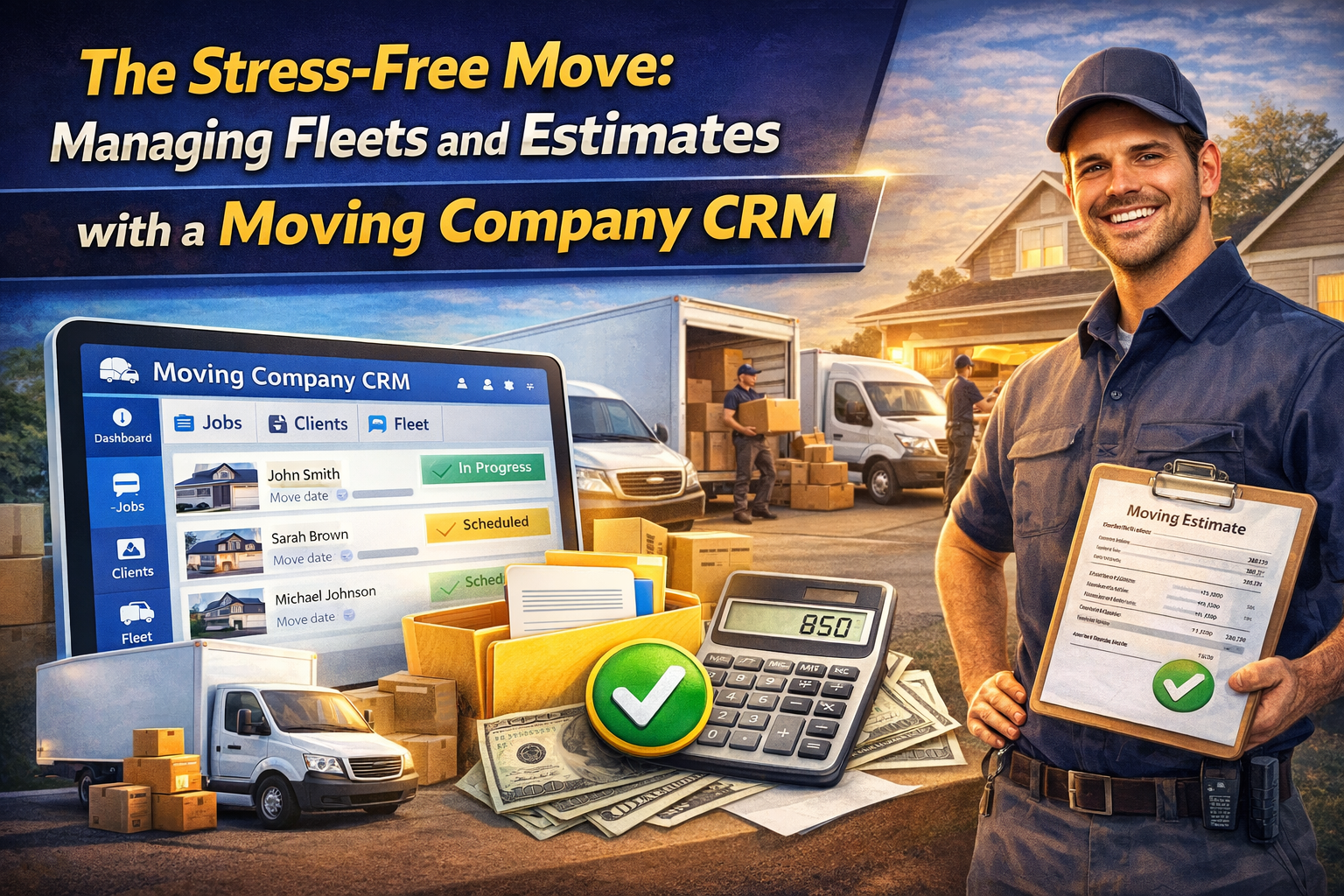
Eliminate scheduling chaos and win more real estate referrals. Discover how a dedicated Moving Company CRM streamlines fleet management and accurate estimates.
Table of Contents
Every real estate agent knows the absolute dread of a botched moving day. You’ve navigated a turbulent housing market, successfully negotiated the repairs, and finally reached the finish line. Then, your client calls in a panic because their movers double-booked the truck and are nowhere to be found. The domino effect of a delayed move is terrifying for everyone involved.
This is exactly why top-producing agents are now paying close attention to the logistics side of the transaction. We are actively looking for vendor partners who utilize a robust Moving Company CRM to handle their fleets and estimates. It’s no longer just about who has the biggest trucks; it’s about who has the infrastructure to guarantee a seamless transition from one property to the next.
The Closing Day Domino Effect
When an investor is flipping a house or a family is vacating to close an active listing agreement, timing is everything. A delay doesn’t just mean waiting around; it can literally delay funding and breach a real estate contract. Traditional pen-and-paper dispatching is a recipe for disaster in these tight windows.
By implementing a Moving Company CRM, dispatchers can visualize their entire fleet on a single digital dashboard. They see exactly where truck number four is, how long the load-out is taking, and if the crew will make the afternoon window. This real-time data prevents the kind of scheduling overlaps that leave families stranded on the curb with all their worldly possessions.
Why Real Estate Agents Recommend Tech-Forward Movers
Real estate professionals live and die by their referral networks. If I recommend a mover to my clients and that company delivers a phenomenal, transparent experience, it makes me look like a rockstar. On the flip side, if the mover ruins the day, the client remembers my bad recommendation, not just the bad service.
Because a Moving Company CRM standardizes the entire customer journey, it removes the guesswork. From the first phone call to the final box being unloaded, the client receives automated updates and clear communication. This level of professionalism is exactly what high-end agents demand before handing over their client list.
The Power of the In-Home Estimate
Let’s talk about the money. Buyers are often financially tapped out by closing costs, down payments, and inspection fees. The absolute last thing they need is a “ballpark” moving quote that suddenly doubles once the truck is loaded.
A modern Moving Company CRM allows the estimator to walk through the property with a tablet, tap on the visual inventory (three couches, two beds, a massive gun safe), and generate a legally binding quote on the spot. This precision protects the consumer and builds massive trust. When the numbers make sense and are guaranteed, the anxiety of the move drops significantly.
Dispatching and Fleet Scheduling
Routing a fleet of 26-foot box trucks through a busy metro area is a massive logistical challenge. You have to account for low bridges, strict HOA parking rules in newly developed residential neighborhoods, and narrow historic streets. Advanced software handles this effortlessly. A Moving Company CRM integrates complex GPS tracking directly with the daily job schedule.
If a crew finishes a job at a small condo two hours early, the system immediately knows. The Moving Company CRM instantly alerts the central dispatcher so they can reroute that crew to assist a larger job across town that might be running behind. This fluidity maximizes the company’s daily revenue while ensuring no client is left waiting in an empty house.
Adapting to Escrow Delays and Changing Timelines
Any seasoned professional knows that escrow doesn’t always close on time. Wires get delayed, title companies find last-minute hiccups, and suddenly the buyers can’t get the keys to their new house until tomorrow. What happens to the fully loaded moving truck?
When a logistics team uses a Moving Company CRM, adjusting the schedule is a matter of dragging and dropping a digital block. The system automatically calculates the overnight storage fees or truck detention time, updates the invoice, and sends the revised contract to the client for a digital signature. It takes a highly stressful delay and handles it with cool, administrative efficiency.
Turning Renters into Lifelong Clients
The turnover phase is notoriously brutal for those working in property management. You have tenants moving out of your rental properties on the 31st and new ones moving in on the 1st. Coordinating elevator reservations and loading dock times in a high-rise building is a delicate dance.
When the moving crews use a centralized Moving Company CRM, they can communicate arrival windows directly with the building manager via automated text messages. This cuts down on lobby congestion, prevents accidental damage to common areas, and keeps the transition smooth. When a property manager sees this level of organization, that moving company becomes their exclusive vendor.
Bridging the Gap in Commercial Real Estate Moves
Moving a family of four is one thing; relocating a corporate headquarters is an entirely different beast. The level of detail required for a commercial real estate move demands heavy-duty digital infrastructure. You are dealing with hundreds of cubicles, sensitive IT equipment, and strict building insurance requirements.
A Moving Company CRM provides the necessary framework to assign multiple trucks and specialized crews over a multi-day period. It keeps the corporate client updated with daily progress reports, ensuring they can resume business operations with minimal downtime. For more context on the sheer scale of commercial logistics and vehicle routing, the Wikipedia page on Fleet Management offers an excellent breakdown of why centralized tracking is mandatory for large-scale operations.
Protecting the Investment Property During the Move
Moving heavy furniture damages houses. Scratched hardwood floors, dinged drywall, and torn carpets are the bane of every seller’s existence. When an investor is preparing to list a newly renovated investment property, the last thing they want is the movers destroying the fresh paint job.
Because a Moving Company CRM logs every interaction, email, and signed document, there is a clear record of liability. The crew can take “before and after” photos of the property and upload them directly to the client’s file. If a dispute over a scratched floor arises, the management team can instantly pull up the photos to verify the claim, protecting both the homeowner and the moving business.
Essential Features to Look For
If you are evaluating logistics partners for your real estate brokerage, or if you run a moving business looking to upgrade, here are the non-negotiables:
- Visual Estimating: The ability to build an inventory list on a mobile device.
- Digital Contracts: E-signature capabilities for bills of lading and liability waivers.
- Real-Time Dispatch: GPS integration to track crew locations and truck idle times.
- Automated Communication: SMS and email triggers to keep the homeowner informed.
According to data and insights from the National Association of Realtors, the physical act of moving is consistently ranked as one of the most stressful life events a person will ever experience. A dedicated system attacks that stress by providing a clear, communicative, and reliable framework that puts the buyer at ease.
Moving Company CRM
The Hidden ROI of Better Logistics
Running a profitable moving business is all about minimizing empty miles and maximizing crew efficiency. You simply cannot do that on a dry-erase board anymore. Upgrading to a specialized Moving Company CRM allows owners to analyze profit margins per job, track fuel costs, and monitor individual crew performance.
If an estimator is consistently under-bidding jobs just to win the contract, the Moving Company CRM flags the financial discrepancy before it eats into the company’s annual profits. It turns a chaotic service business into a finely tuned, data-driven machine. This financial health means the company will stay in business long enough to help your clients move again in five to seven years.
FAQ Section
1. Can a Moving Company CRM handle long-distance interstate moves? Yes. High-quality systems are built to manage both local hourly jobs and long-distance weight-based moves. They can calculate tariffs, track interstate compliance documents, and manage complex cross-country delivery windows.
2. How does this software help with customer communication? It eliminates the “where are you?” phone calls. The system can send automated text messages when the crew is dispatched, providing the homeowner with a real-time ETA, much like a modern ride-sharing app.
3. Is a Moving Company CRM expensive for a small local fleet? Not necessarily. Most modern platforms operate on a SaaS (Software as a Service) model, meaning you pay a monthly subscription based on the number of trucks or users. The time saved on dispatching and estimating usually covers the cost within the first few days of the month.
4. How does this benefit the referring real estate agent? When you refer a company that uses top-tier software, your client experiences a smooth, transparent move. This reflects positively on you as an agent, increasing the likelihood of positive reviews and future referrals for your own real estate portfolio.
5. Do these systems handle claims and damages? Yes, most include a claims management module. Clients can upload photos of damaged items directly to their portal, and the management team can process the insurance payout or repair request entirely within the software, keeping the paperwork organized.
