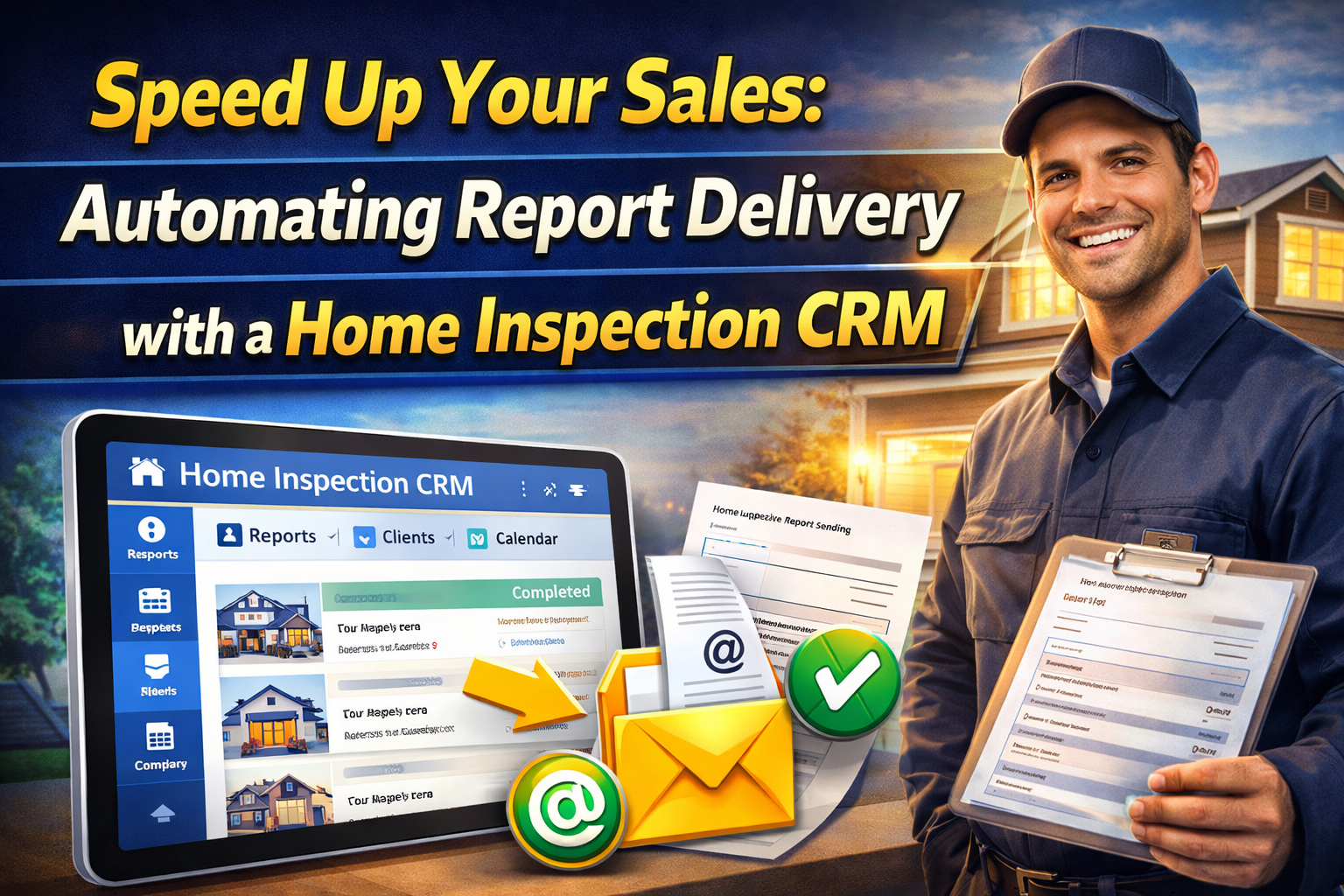
Close deals faster by automating your workflow. Learn how a Home Inspection CRM streamlines report delivery, improves client trust, and boosts real estate sales.
Table of Contents
If you’ve spent any time in the trenches of the local housing market, you know the exact moment the collective breath is held: the inspection period. The house is under contract, the buyers are picking out paint colors, and the sellers are mentally packing their boxes. Then, the inspector walks in. For twenty-four to forty-eight hours, everyone is in a state of suspended animation waiting for that PDF to hit their inbox.
In my years of blogging about the industry, I’ve seen more deals fall apart due to delays and poor communication during this window than almost any other phase. This is why I’m such a massive advocate for professionals using a dedicated Home Inspection CRM. It’s not just about keeping a list of contacts; it’s about the sheer velocity of information. When a report is delivered automatically and clearly, the friction of the transaction virtually disappears.
The Bottleneck of Manual Reporting
We’ve all worked with that one inspector—the guy who is brilliant at finding a faulty HVAC or a cracked foundation but takes three days to type up his notes. In a competitive buyer’s market, three days is an eternity. By the time the report arrives, the buyer’s cold feet have turned into blocks of ice.
A high-quality Home Inspection CRM solves this by allowing the inspector to input data in real-time. Instead of waiting to get back to a home office, the automation handles the heavy lifting. The moment the inspection is finalized, the software can trigger a delivery sequence that sends the report to the buyer, the listing agent, and the buyer’s agent simultaneously. This kind of speed is what keeps a real estate portfolio growing rather than stagnating in “Pending” status.
Why Real Estate Agents Love Automated Workflows
From an agent’s perspective, a Home Inspection CRM is a godsend for project management. We are already juggling mortgage rate fluctuations and title issues; we don’t want to be the middleman for a PDF file.
When an inspector uses a Home Inspection CRM, the report usually comes with a summary of high-priority repairs. This allows the agent to immediately start drafting a repair addendum or a credit request. It turns a reactive process into a proactive one. If you’re a listing agent, receiving that report quickly means you can help your sellers digest the news and get quotes for repairs before the contingency period expires.
Improving the Buyer Experience
First-time homebuyers are notoriously anxious. They view the inspection as a “pass/fail” test for their future home. A Home Inspection CRM often provides a professional, web-based interface for the report rather than a clunky, 50-page document that’s hard to read on a phone.
Interactive reports—complete with expandable photos and videos—help buyers understand the difference between a major structural issue and a minor cosmetic flaw. This clarity is essential for maintaining a high conversion rate on your contracts. According to industry insights at Realtor.com, clear communication is the number one factor in reducing “buyer’s remorse” during the inspection phase.
Investing in Better Data for Investors
For real estate investors, time is literally money. If you are flipping houses or building a stash of rental properties, you need to know the “buy or walk” status of a property within hours.
I know several wholesalers who won’t even hire an inspector unless they use a modern Home Inspection CRM. They need that automated delivery to feed into their own spreadsheets for a comparable market analysis (CMA). If the inspection reveals $20,000 in unexpected roof work, the investor needs to renegotiate immediately or move on to the next lead.
The Role of CRM in Commercial Real Estate
Don’t think this is just for small bungalows. In commercial real estate, the due diligence period is even more grueling. You’re looking at environmental reports, ADA compliance, and massive mechanical systems.
A Home Inspection CRM built for scale can handle these multi-faceted reports, delivering them in sections to different stakeholders. It ensures the electrical engineer, the plumber, and the lead broker all have the data they need at the exact same time. This level of synchronization is what separates the top-tier firms from the amateurs.
Managing the “Post-Inspection” Fallout
Once the report is delivered via the Home Inspection CRM, the real work begins. This is where many agents struggle with property management and vendor coordination.
Some advanced CRM platforms allow you to create a “Repair Request List” directly from the report photos. Instead of copy-pasting text into an email, you check a few boxes, and a neat list is generated. This saves hours of administrative work and ensures that the escrow officer has a clear trail of what was agreed upon regarding repairs.
Transparency and Trust in the Housing Market
We live in an age where people expect transparency. If an inspector is secretive or slow, it raises red flags for the buyer. When an inspector says, “I’ll be using a Home Inspection CRM to send you the report by 5:00 PM today,” and that email hits the inbox at 4:59 PM, it builds immense trust.
That trust extends to the agent who recommended the inspector. If you recommend a pro who uses a Home Inspection CRM, you look like a tech-forward expert. If you recommend someone who still uses a carbon-copy notepad, you look like you’re stuck in 1994. In real estate, your reputation is your only real currency. You can read more about the standards of practice on the Wikipedia page for Home Inspection.
The Hidden ROI of Automation
You might think that a Home Inspection CRM is just an expense for the inspector, but it’s actually a revenue driver for the entire circle of the sale.
- Fewer Canceled Contracts: Speed reduces the “anxiety gap” where buyers get cold feet.
- Higher Referral Rates: Clients remember a smooth process.
- Better Documentation: If a dispute arises months after the listing agreement is closed, having a cloud-based record in the CRM is a lifesaver.
Security and Compliance
In the world of residential real estate, data privacy is becoming a huge talking point. Sending sensitive property reports via unencrypted email is a risk. A reputable Home Inspection CRM provides secure links and password protection for reports. This protects the seller’s privacy and the buyer’s investment data, ensuring that the only people seeing the report are those authorized to do so.
Integrating with the Rest of the Tech Stack
A standalone tool is good, but a tool that talks to your other software is better. Many Home Inspection CRM options now integrate with popular real estate platforms. This means that as soon as the inspection is marked as “complete,” your transaction management software can check off a task, notify the lender, and move the file one step closer to closing.
It’s about creating a “frictionless” experience. When the Home Inspection CRM handles the delivery, the agent can spend more time finding new investment properties and less time playing phone tag with the inspector.
Scaling Your Inspection Business
If you’re an inspector looking to grow, you simply can’t do it manually. There aren’t enough hours in the day. Using a Home Inspection CRM allows you to handle more volume without sacrificing quality. It gives you the “big firm” feel even if you’re a one-person operation.
Automated report delivery means you can spend your evenings with your family instead of hunched over a laptop typing up descriptions of leaky faucets. For the agents you work with, that reliability makes you a “preferred vendor” for life.
Final Thoughts on the Human Side of Tech
Technology often gets a bad rap for being “cold,” but in this case, it actually facilitates better human interaction. By removing the stress of waiting, a Home Inspection CRM allows the buyer and seller to have a more rational, calm conversation about the property.
At the end of the day, we are all trying to help people find a place to call home. Whether it’s a first-time residential real estate purchase or a complex commercial deal, the tools we use matter. Automating the report delivery via a Home Inspection CRM is one of those small changes that has a massive ripple effect on the success of a transaction.
FAQ Section
1. Does a Home Inspection CRM work on all devices? Most modern platforms are cloud-based and mobile-responsive. This allows inspectors to take photos and log findings on a tablet or phone while on-site, which is what triggers the automated delivery once they finish the walkthrough.
2. Can an agent access the report directly through the CRM? Yes, typically the Home Inspection CRM will send a secure link to the agent as well as the client. Many systems also allow for a “Real Estate Dashboard” where agents can see all their past and current inspections in one place.
3. Is it possible to customize the reports? Absolutely. Most Home Inspection CRM software allows for custom branding, tailored comments, and specific sections for different property types, from condos to multi-unit rental properties.
4. How does automation help with repair negotiations? Because the report is delivered so quickly and often includes a “repair builder” feature, agents can instantly generate a list of requested fixes to send to the seller. This keeps the escrow process moving forward without manual data entry.
5. Is the data stored in the CRM forever? Storage policies vary, but most reputable Home Inspection CRM providers offer long-term cloud storage. This is vital for liability protection and for agents who might need to refer back to a report for a future comparable market analysis.
