
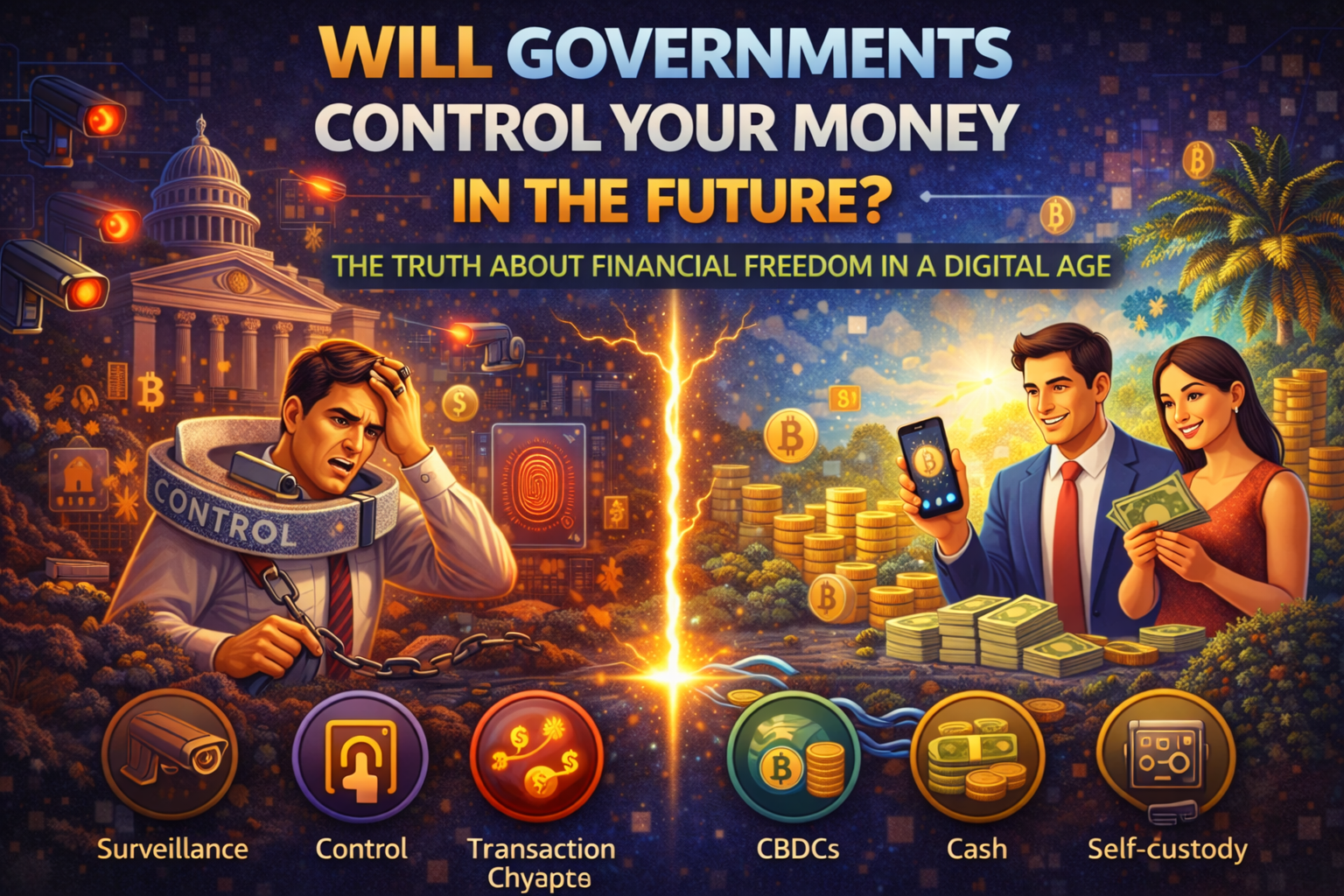
Will governments control your money in the future? Explore CBDCs, digital payments, and the growing influence of governments over personal finances in 2026.
Table of Contents
Introduction
Money has always been a symbol of freedom.
It gives you the ability to choose, spend, invest, and live life on your own terms. But as the world moves toward digital finance, a new and uncomfortable question is emerging:
👉 Will governments control your money in the future?
With the rise of digital currencies, cashless economies, and increasing regulations, the relationship between individuals and money is changing rapidly.
In this blog, we uncover the reality behind this shift—and what it means for your financial freedom.
The Shift from Cash to Digital Money
Over the last decade, we’ve seen a massive transformation:
- Cash usage is declining
- Digital payments are rising
- Mobile wallets and UPI are becoming dominant
👉 Governments support this shift because digital transactions are:
- Easier to track
- More transparent
- Harder to evade taxes
📌 Learn about digital payments:
https://www.worldbank.org/en/topic/paymentsystemsremittances
What Are CBDCs (Central Bank Digital Currencies)?
CBDCs are digital versions of national currencies issued by central banks.
Unlike cryptocurrencies:
- They are government-controlled
- They are centralized
- They operate within legal frameworks
👉 Examples include:
- Digital Rupee (India)
- Digital Yuan (China)
📌 Learn more about CBDCs:
https://www.bis.org/publ/arpdf/ar2021e3.htm
How Governments Could Control Money
If digital currencies become dominant, governments could gain more control over financial systems.
🔍 1. Transaction Monitoring
Every transaction can be tracked in real time.
👉 This reduces illegal activities—but also reduces privacy.
⛔ 2. Spending Restrictions
In theory, governments could:
- Limit where money can be spent
- Restrict certain purchases
- Control usage during crises
👉 This raises serious concerns about personal freedom.
⏱️ 3. Expiry-Based Money
Some economists suggest programmable money that:
- Expires after a certain time
- Encourages spending
👉 While useful for economic stimulation, it limits saving behavior.
🧾 4. Tax Automation
Taxes could be:
- Deducted automatically
- Enforced instantly
👉 This increases efficiency—but reduces flexibility.
Why Governments Want More Control
Governments argue that these systems can:
- Reduce corruption
- Prevent money laundering
- Improve tax collection
- Strengthen economic stability
👉 From a policy perspective, digital control can improve governance.
📌 Financial regulation insights:
https://www.imf.org/en/Topics/fintech
The Risks to Financial Freedom
While there are benefits, there are also risks:
⚠️ Loss of Privacy
Your financial behavior could be fully visible.
⚠️ Centralized Power
Too much control in one system can be dangerous.
⚠️ Potential Misuse
In extreme cases, governments could:
- Freeze accounts
- Limit access to funds
👉 This is where concerns about financial surveillance arise.
Is This Already Happening?
In some ways—yes.
- Digital payment tracking already exists
- Banks report transactions to regulators
- Governments monitor financial flows
👉 The difference is scale and control.
CBDCs could take this to a new level.
The Role of Cryptocurrencies
Cryptocurrencies like Bitcoin were created as an alternative:
- Decentralized
- Not controlled by governments
- Based on blockchain technology
👉 They offer more freedom—but come with:
- Volatility
- Regulatory uncertainty
📌 Crypto basics:
https://www.investopedia.com/terms/c/cryptocurrency.asp
The Future: Control or Balance?
The future is unlikely to be extreme.
👉 It will likely be a balance between:
- Government control
- Individual freedom
We may see:
- Coexistence of cash, digital money, and crypto
- Regulations with privacy safeguards
- Hybrid financial systems
What This Means for You
As an individual, you should:
💡 Stay Informed
Understand how financial systems are evolving.
💰 Diversify Assets
Don’t rely on a single financial system.
🔐 Protect Privacy
Be aware of how your financial data is used.
👉 Financial awareness will become more important than ever.
Conclusion
So, will governments control your money in the future?
👉 Partially—yes. Completely—unlikely.
The shift toward digital finance is inevitable. But how much control governments have will depend on:
- Policies
- Public awareness
- Technological choices
Final Thought
The real question is not just about control.
👉 It’s about balance.
How do we create a system that is:
- Secure
- Transparent
- Efficient
…without sacrificing freedom?
Because in the future of money,
👉 control and freedom will always be in tension.
Discover hidden bank fees that quietly drain your money. Learn how banks charge you secretly and smart strategies to avoid these costs in 2026.
