
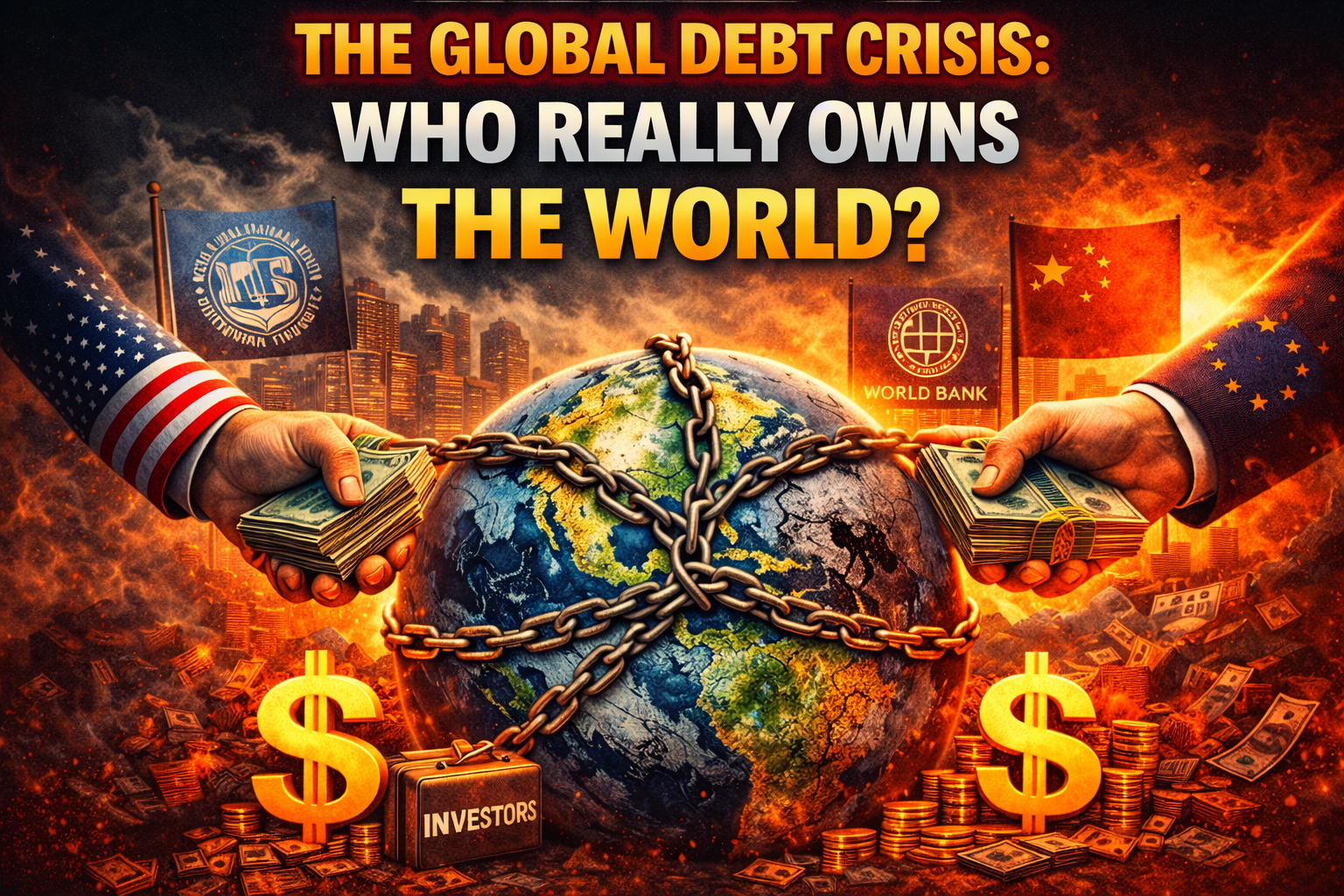
The Global Debt Crisis: Who Really Owns the World?: The world runs on debt—but who really controls it? Discover the hidden power behind global lending and financial control.
Table of Contents
Imagine this:
Countries run on loans.
Governments borrow to survive.
People pay taxes… not just for development — but to repay debt.
Now ask yourself:
If everyone is in debt… who actually owns the world?
Welcome to the Global Debt Crisis — a system so deeply embedded that most people don’t even question it.
What is the Global Debt Crisis?
The global debt crisis refers to the massive amount of money owed by governments, corporations, and individuals worldwide.
Today:
- Countries owe trillions of dollars
- Companies survive on borrowed capital
- Individuals live on EMIs and credit
The world economy is no longer driven by savings…
It is driven by debt.
The Scale of the Problem
Global debt has crossed hundreds of trillions of dollars, far exceeding the world’s total economic output.
This includes:
- Government Debt
- Corporate Debt
- Household Debt
In simple terms:
We owe more money than we actually produce.
Who Lends This Money?
Here comes the most important question.
1. Central Banks
Institutions like the US Federal Reserve print money and lend it into the system.
They control:
- Interest rates
- Money supply
- Economic cycles
2. Commercial Banks
Banks give loans to:
- Individuals (home, car, personal loans)
- Businesses (expansion, operations)
They earn through interest — the backbone of the financial system.
3. Global Institutions
Organizations like the International Monetary Fund and World Bank lend money to countries.
But loans come with conditions:
- Policy changes
- Economic reforms
- Structural adjustments
This is where finance meets global power.
4. Investors & Bond Markets
Governments raise money by issuing bonds.
Who buys them?
- Big institutions
- Wealthy investors
- Even other countries
Yes, countries lend money to other countries.
The Power Game Behind Debt
Debt is not just financial — it is geopolitical power.
Example:
When a country cannot repay loans:
- It loses bargaining power
- It may have to change policies
- It can even give up control over assets
Debt becomes a tool of influence.
Case Study Thinking
- Developing nations borrow for growth
- Developed nations lend for influence
This creates a cycle:
The rich lend. The poor repay.
And the gap keeps increasing.
The Real Truth
Money is not just currency — it is control.
Whoever controls:
- Money supply
- Lending system
- Interest rates
Controls the economy.
And whoever controls the economy…
controls the world.
Why This System Continues
Because it benefits the system:
- Governments can spend beyond limits
- Banks earn from interest
- Economies grow through consumption
But at a cost:
Permanent dependence on debt
Is Debt Always Bad?
No.
Productive Debt
- Infrastructure
- Business growth
- Innovation
Destructive Debt
- Over-borrowing
- Poor financial planning
- Corruption
The problem is not debt —
the problem is uncontrolled debt.
Final Thought: Who Really Owns the World?
Not the richest person.
Not the biggest company.
But those who control:
- Lending
- Currency
- Financial systems
Because ownership today is not about land…
it’s about liabilities.
