
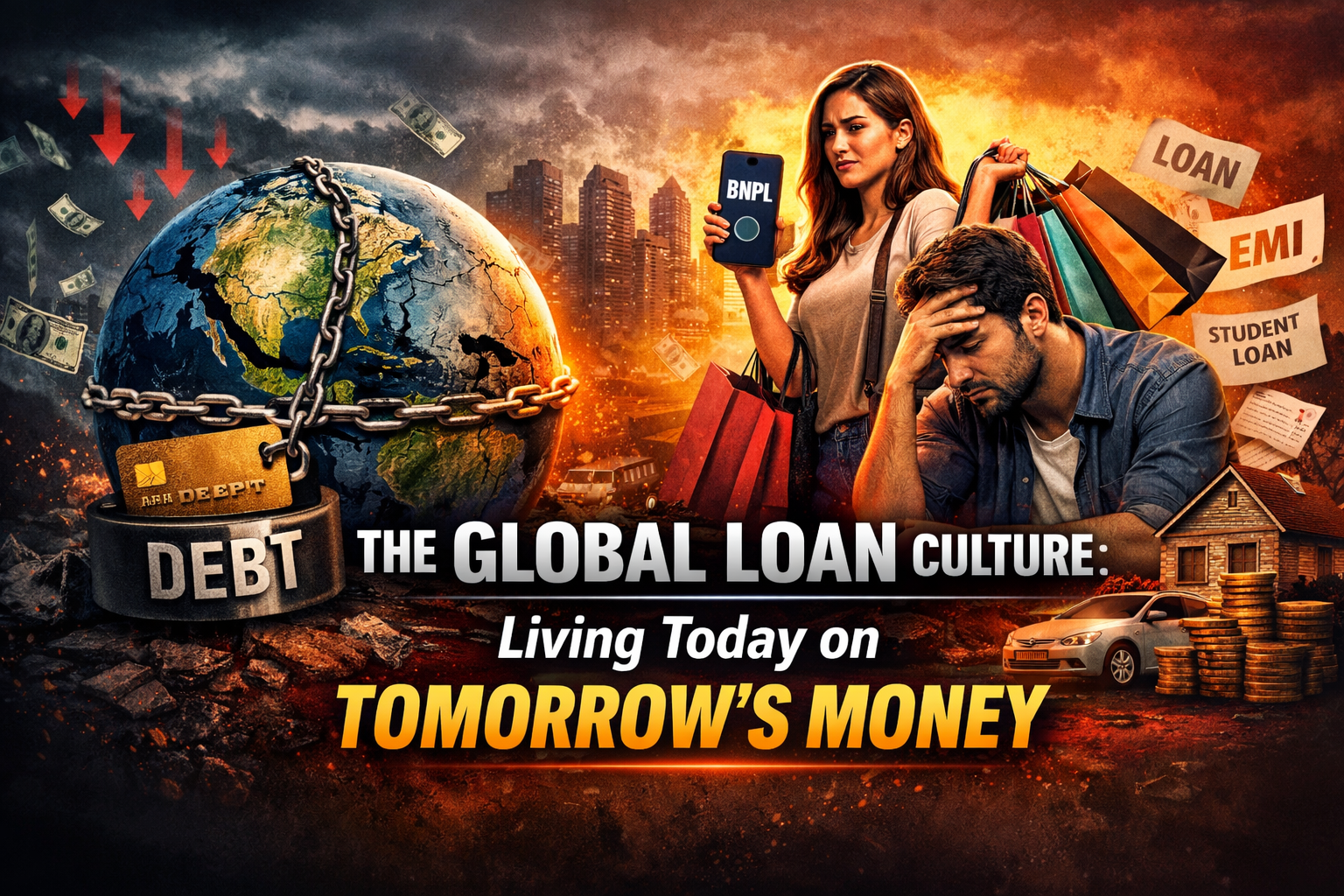
The Global Loan Culture: Living Today on Tomorrow’s Money: The world is living on borrowed money. Discover how global loan culture is trapping millions in debt and silently destroying wealth.
Table of Contents
Introduction: The New Normal Nobody Questions
A 22-year-old buys the latest smartphone: The Global Loan Culture: Living Today on Tomorrow’s Money
Not with savings — but on EMI.
A young professional books an international trip.
Not with surplus income — but on a credit card.
A family upgrades their lifestyle.
Not because they can afford it — but because they can finance it.
Welcome to the Global Loan Culture — a world where borrowing is no longer a backup plan… it is a lifestyle.
What is Global Loan Culture?: The Global Loan Culture: Living Today on Tomorrow’s Money
Global Loan Culture refers to a financial ecosystem where people, businesses, and even governments rely heavily on borrowed money to sustain growth and lifestyle.
Today:
- Credit cards are status symbols
- EMIs are considered “affordable living”
- Loans are approved faster than jobs
We are not spending what we earn.
We are spending what we expect to earn in the future.
Why the World Shifted to Debt
1. Instant Credit, Zero Friction
With fintech apps and digital banking, loans are now available in minutes.
No paperwork. No waiting. Just a few taps — and you’re in debt. :The Global Loan Culture: Living Today on Tomorrow’s Money
2. The Rise of Consumerism
Social media has redefined success:
- Better phone
- Better clothes
- Better lifestyle
And if you can’t afford it?
No problem — finance it.
3. EMI Illusion
₹3,000 per month feels small.
But ₹3,000 × 24 months = ₹72,000.
Most people don’t calculate the total cost — they only see the monthly comfort. :The Global Loan Culture: Living Today on Tomorrow’s Money
4. Economic Dependency on Spending
Countries need people to spend money to grow GDP.
And the easiest way to increase spending?
Make borrowing easy.
The Hidden Dangers
1. The Debt Trap Cycle
One loan leads to another.
EMIs pile up.
Savings disappear.
Eventually, people don’t work to build wealth —
they work to pay liabilities.
2. Mental Pressure & Stress
Behind every “luxury lifestyle” post is often:
- Financial anxiety
- Job dependency
- Fear of missing EMI payments
This is the silent mental health crisis of finance.
3. Wealth Destruction
Instead of earning interest, you are paying it.
While investors grow wealth through compounding,
borrowers lose wealth through reverse compounding (interest payments).
4. The Illusion of Being Rich
A car on loan.
A phone on EMI.
A vacation on credit.
From the outside: Success.
From the inside: Liability.
You don’t own your lifestyle.
Your bank does.:The Global Loan Culture: Living Today on Tomorrow’s Money
Global Reality Check
- In the United States, student loan debt has crossed trillions of dollars
- In India, Buy Now Pay Later (BNPL) is growing rapidly among youth
- In China, excessive borrowing in real estate triggered massive financial instability
This is not a local issue.
This is a global pattern.
The Truth Nobody Tells You
The system thrives when you stay in debt.
Because:
- A borrower is predictable
- A borrower is dependent
- A borrower keeps the economy running
But a debt-free individual?
Has freedom, choices, and control.
Are All Loans Bad?
No. The problem is not loans — it’s how and why we use them.
Good Debt
- Education (with strong earning potential)
- Business investment
- Assets that generate income
Bad Debt
- Luxury purchases
- Trend-driven spending
- Depreciating assets
Final Thought: Break the Cycle :The Global Loan Culture: Living Today on Tomorrow’s Money
Global Loan Culture is designed to make borrowing feel normal.
But normal doesn’t always mean right.
Before taking your next loan, ask yourself:
- Am I buying value or validation?
- Can I afford this without debt?
- Is this building my future… or borrowing from it?
Because in the end:
“If you don’t control your money,
your money will control your life.”
